

Blog

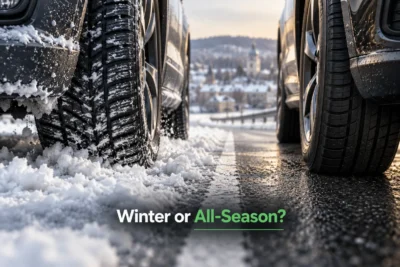
Every October, the same question comes up at our shop: do I really need winter tires or will my all-seasons get me through? If you’re weighing winter tires vs all-season tires York PA drivers can count on, the honest answer depends less on the forecast and more on temperature, your route and how much risk you’re willing to carry.
York winters don’t announce themselves. One morning it’s 50°F. The next, it’s freezing drizzle on Route 30 and brake lights all the way to the interstate. This guide gives you a straight answer, the reasoning behind it and a simple way to decide before the first cold snap.
Quick Answer: Which Tire Is Better for York, PA Winters?
For most drivers, it comes down to your roads and your schedule.
– Choose all-season or all-weather tires if you commute mostly on plowed main roads and can stay home during the worst storms.
– Choose dedicated winter tires if you drive hilly back roads, start work before the plows finish, tow or simply can’t afford a slide.
Winter tires grip better and stop shorter once temperatures drop below 45°F. All-seasons are the convenient compromise. Neither choice is wrong. They solve different problems.
How Winter Tires and All-Season Tires Actually Differ
Both tires are round and black, so it’s easy to assume they behave alike. They don’t. Two design choices separate them.
Rubber Compound
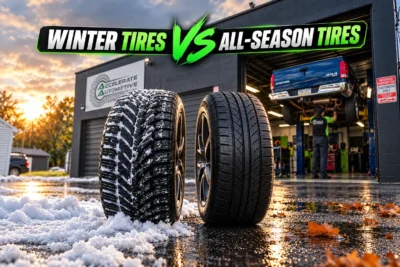
All-season rubber stiffens as the air gets cold. Stiff rubber can’t mold itself to the tiny texture of the road, so grip fades even on dry pavement. Winter tire rubber is formulated to stay flexible in the cold, which keeps more of the tire in contact with the road when you brake or turn.
Tread Design and Biting Edges
Winter tires have deeper grooves and thousands of tiny slits called sipes. The grooves pack in snow and throw it out as the tire rolls, so the tread keeps finding fresh road. The sipes add biting edges that claw at ice and packed snow.
All-season tires trade some of that bite for a quieter ride, longer tread life and decent wet-road manners. That’s a smart trade for three seasons. In January, it’s a different story.

Why 45°F Matters More Than Snow
Most drivers wait for a snowstorm to think about tires. By then, they’ve already spent weeks on rubber that’s going stiff.
The dividing line is temperature. Below roughly 45°F, all-season and summer compounds start losing grip, snow or no snow. In south-central Pennsylvania, plenty of mornings from late November through March sit under that mark. A cold, dry road at 30°F is exactly where a winter tire earns its keep.
Pro tip: if your daily average temperature is hovering below 45°F, it’s time to book the swap. Check the National Weather Service State College forecast a few days ahead so you aren’t scrambling after the first storm.
Are All-Weather Tires a Middle Ground?
Yes and they’re often overlooked. All-weather tires carry the three-peak mountain snowflake symbol on the sidewall, which means they’ve met a minimum snow traction standard. You can run them all year with no seasonal swap.
Here’s the catch. That symbol is based on forward traction in snow. It doesn’t certify braking or cornering on ice. A good all-weather tire is a real step up from a basic all-season. It still won’t match a dedicated winter tire when roads turn icy.
For a driver who wants better winter grip without storing a second set, all-weather tires are a sensible answer.
Winter Tires vs All-Season Tires York PA: Which Fits Your Roads?
Look at the roads you drive, not the average snowfall. You’re a strong candidate for winter tires if any of these sound familiar:
– You live or work on hilly roads in the southern or western parts of York County.
– You leave early, before crews have treated the roads.
– You drive Route 30 or I-83 regularly in the dark.
– Your vehicle is rear-wheel drive or lightly loaded in the back.
– You tow, haul equipment or run a work vehicle.
– You have a long stopping distance to worry about, like a heavy SUV or truck.
If your winter is a short trip on well-plowed streets, quality all-seasons or all-weather tires are usually enough. Just keep your tread healthy and your pressure right.

Does All-Wheel Drive Replace Winter Tires?
No. All-wheel drive helps you get moving. It does nothing extra for stopping or steering.
Your tires are the only part of the vehicle that touches the road. An AWD SUV on worn all-seasons can accelerate confidently and still slide through an intersection. Pairing AWD with winter tires is the strongest setup, because you gain traction for both going and stopping.
Winter Tire Installation Cost in York, PA: What Affects the Price
We won’t quote a number here, because the real price depends on your vehicle. Several factors move it:
– Tire and wheel size
– Whether your vehicle has tire pressure monitoring sensors that need attention
– Whether you’re mounting winter tires on your current wheels or on a separate set
– Balancing, which every set needs
– Disposal of old tires
Here’s a money-saving detail many drivers miss. Mounting winter tires on a second set of wheels makes every future changeover faster and simpler, since the tires stay mounted and balanced. Swapping tires on a single set of wheels each season works too. It just means paying for mounting and balancing twice a year.
Ready for a number? Call us with your vehicle and tire size. We’ll give you a clear estimate for your seasonal tire changeover in York, PA.
When Should You Switch to Winter Tires?
Aim for late October through mid-November. Once average temperatures settle below 45°F, make the switch. Waiting for the first snowfall means competing with everyone else who waited.
A few rules we’d stand behind:
– Install a full set of four. Mixing winter tires on one axle with all-seasons on the other can leave the vehicle unbalanced in a slide.
– Swap back in spring. Winter tires wear faster on warm, dry pavement, so don’t leave them on through summer.
– Book early. Appointments tighten fast after the first freeze.

What to Check Before You Commit
Before you buy anything, look at what’s already on your car.
– Tread depth: Worn all-seasons lose their snow and slush performance first. If the tread is getting low, replacing them may beat adding a second set.
– Tire age: Rubber hardens with time, even on tires that look fine.
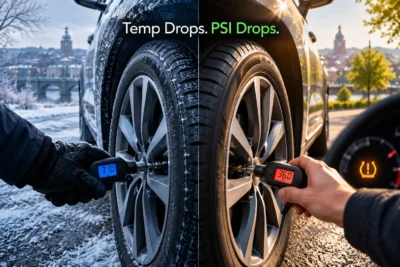
– Tire pressure: Cold air lowers pressure. The National Highway Traffic Safety Administration recommends checking pressure regularly and using the number on your door placard, not the one on the tire sidewall.
– Mounting and balance: A poorly balanced tire vibrates, wears unevenly and wastes your money. Proper tire mounting and balancing in York, PA is the step that protects your investment.
Bring the vehicle in and we’ll look at all four before you decide.
Winter Tire Changeovers at Accelerate Automotive
We’re a York-based auto repair shop with two locations: 1231 W. Locust Street and 1221 W. Heiges Ave, in West York. We handle the full range of tire services in York, PA, including changeovers, mounting,and balancing, for drivers across York and the surrounding 30-mile area.
Our hours are Monday through Friday, 10:00 a.m.–6:00 p.m. and Saturday, 9:00 a.m.–2:00 p.m. Evening appointments are available. 24/7 drop-off is there if your schedule won’t line up with ours. Call to ask about same-day availability.