

Blog

A rough idle, sudden shaking, weak acceleration or a flashing check engine light can turn a normal drive into a stressful one quickly. If you are searching for engine misfire repair York PA, the most important step is finding the reason the engine is misfiring before replacing parts.
A misfire is a symptom, not a single repair. Spark, fuel, air, compression, timing and electrical faults can all produce similar behavior.
For drivers in York and West York, this guide explains what a misfire means, the most common causes, how repair costs can change, what diagnostic trouble codes can and cannot tell you and when continuing to drive can put the vehicle at greater risk.
What Is an Engine Misfire?
An engine misfire happens when combustion in one or more cylinders does not occur correctly. A gasoline engine needs the right amount of air and fuel, adequate compression and a properly timed spark.
If one of those pieces is missing or outside its normal range, the affected cylinder may contribute less power than it should or fail to fire properly.
Some misfires are obvious. The vehicle may shake at idle or stumble when you press the accelerator. Others are intermittent and may appear only during a cold start, under load, at highway speed or after the engine reaches operating temperature.
That is why professional engine misfire repair York PA should start with diagnosis rather than guessing from the symptom alone.
What Are the Most Common Signs of an Engine Misfire?
A driver may notice one symptom or several at the same time.
Common warning signs include:
- Rough or uneven idle
- Shaking or vibration while stopped
- Hesitation during acceleration
- Loss of power, especially under load
- Engine sputtering or stumbling
- A steady or flashing check engine light
- Hard starting or occasional stalling
- Reduced fuel economy
- A noticeable change in exhaust sound
These symptoms do not prove which component has failed.
A bad ignition coil can feel similar to a fuel injector problem, vacuum leak or compression issue. That overlap is one reason a code scan is useful, but it is not the same as a complete diagnosis.
What Causes an Engine Misfire?
1. Worn or Fouled Spark Plugs
Spark plugs ignite the air-fuel mixture inside the cylinders. A worn, fouled, damaged or incorrectly gapped plug can create a weak spark or no reliable spark at all.
Depending on the engine design, accessing the spark plugs may be straightforward or may require additional labor.
2. Failing Ignition Coils or Related Ignition Parts
Many modern vehicles use a separate ignition coil for each cylinder. A weak or failed coil can cause a cylinder-specific misfire, especially during acceleration or when the engine is under load.
Older ignition systems may also involve plug wires, distributor components or shared coil packs.
3. Fuel Injector or Fuel Delivery Problems
A cylinder needs the correct amount of fuel at the correct time.
A restricted, electrically faulty or mechanically failing injector can create an inconsistent burn. Fuel-pressure problems may affect several cylinders and require testing beyond the injector itself.
4. Vacuum Leaks or Unmetered Air
Air entering the engine where it should not can upset the air-fuel mixture.
Intake leaks, damaged hoses or sealing problems may cause a lean condition that shows up as a rough idle, hesitation or engine misfire.
Some air leaks are more noticeable at idle and become harder to recognize as engine speed increases. This is another reason symptom-based part replacement can miss the real problem.
5. Low Compression or Internal Engine Problems
A spark plug and ignition coil can both be working normally while the cylinder still misfires.
Burned valves, worn piston rings, head gasket problems, valve-train faults or other mechanical conditions can reduce cylinder compression.
When ignition and fuel checks do not explain the misfire, compression and other mechanical testing may be needed.
6. Timing, Sensor or Electrical Faults
Camshaft and crankshaft position information, engine timing, wiring, grounds and other control inputs can affect combustion.
A technician may need to compare fault codes, live data, wiring integrity and mechanical timing before deciding what actually needs repair.
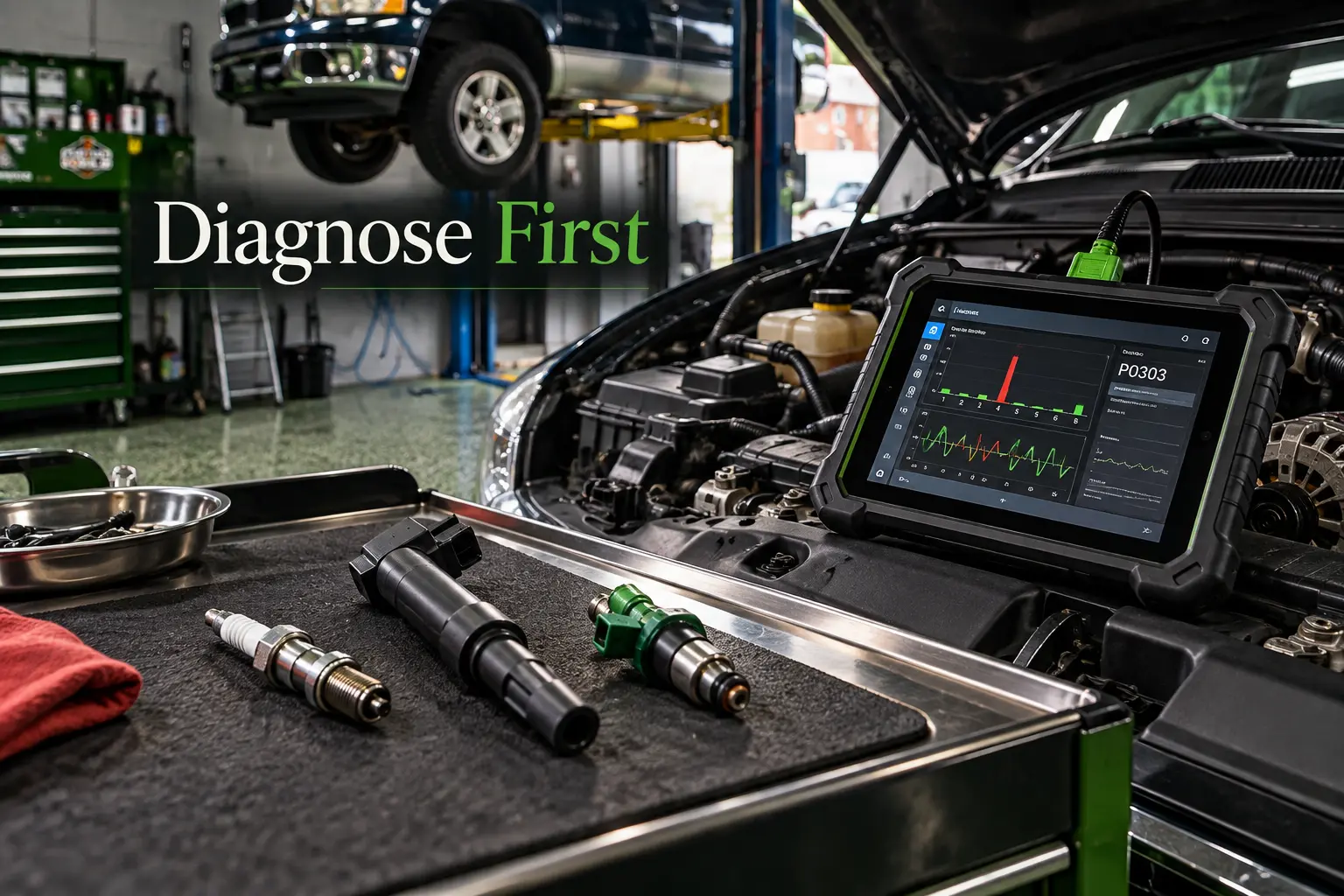
Engine Misfire Repair York PA: Why Diagnosis Comes Before Parts
A trouble code can point the investigation in the right direction, but it usually does not identify the failed part by itself.
For example, a P0301 code means the computer detected a misfire involving cylinder 1. It does not automatically mean cylinder 1 needs a new spark plug or ignition coil.
A proper engine misfire repair York PA process may include checking stored and pending codes, reviewing freeze-frame information, watching live data, inspecting
ignition components, checking fuel delivery, looking for intake leaks and performing compression or other mechanical tests when necessary.
Accelerate Automotive provides engine diagnostics in York, PA for warning lights, fault codes, rough-running engines and other drivability problems.
The goal is to isolate the cause before recommending parts. That can help prevent spending money on repairs that do not solve the misfire.
What Do P0300, P0301, P0302, P0303 and P0304 Mean?
Misfire-related diagnostic trouble codes commonly begin with P030. The final digit can help identify how the misfire is being detected.
- P0300: Random or multiple-cylinder misfire detected
- P0301: Cylinder 1 misfire detected
- P0302: Cylinder 2 misfire detected
- P0303: Cylinder 3 misfire detected
- P0304: Cylinder 4 misfire detected
Engines with more cylinders can store corresponding cylinder-specific codes beyond P0304.
The code is a starting point. Testing still matters because the underlying cause may involve ignition, fuel delivery, air, wiring or the engine’s mechanical condition.
If a warning light appears along with the misfire, Accelerate Automotive also provides check engine light diagnostics in York, PA to help identify what the vehicle’s computer is detecting and what testing should come next.
How Much Does Engine Misfire Repair Cost in York, PA?
There is no reliable flat price for engine misfire repair York PA because “misfire” describes what the engine is doing, not the component that needs to be replaced.
The final repair cost depends on the actual cause, vehicle design, component access, labor time, parts and whether the original problem has contributed to additional damage.
A spark plug replacement, for example, is a very different repair from replacing a fuel injector or repairing an internal compression problem.
This is why an engine misfire repair cost in York, PA becomes meaningful only after the underlying fault has been identified.
Replacing an ignition coil because a P0301 code appeared may look like an inexpensive solution, but it does not help if the real problem is an injector, vacuum leak, wiring fault or low compression.
What Usually Changes the Repair Cost?
Several factors can affect what it costs to fix an engine misfire:
- Vehicle design: Some engines provide easy access to plugs, coils and injectors. Others require considerably more disassembly.
- Number of affected cylinders: A single-cylinder problem may follow a different diagnostic path from a random or multiple-cylinder misfire.
- Root cause: Routine ignition repairs are very different from fuel-system or internal-engine repairs.
- Diagnostic time: Intermittent problems can require additional testing to reproduce and confirm.
- Related damage: Driving with a severe misfire can place additional stress on emissions components.
For this reason, drivers comparing engine misfire repair cost York PA should focus on accurate diagnosis before comparing the price of individual parts.
Can You Drive With an Engine Misfire?
Sometimes a vehicle with a mild, intermittent misfire will still move normally enough to reach a repair facility. That does not mean the problem should be ignored.
A persistent misfire may worsen, reduce engine power, increase fuel consumption and send unburned fuel into the exhaust system.
A flashing check engine light changes the situation.
The U.S. Environmental Protection Agency explains that a flashing malfunction indicator light can indicate a severe level of engine misfire. Severe misfires can damage emissions-control components, particularly the catalytic converter.
You can review the EPA’s on-board diagnostic guidance for additional information.
If the vehicle is shaking severely, losing substantial power, stalling, overheating or producing a strong burning smell, continuing to drive may add risk.
Move to a safe location and arrange professional assistance rather than trying to push the vehicle farther than necessary.
Why Does a Flashing Check Engine Light Need Fast Attention?
When combustion does not happen correctly, fuel may pass into the exhaust instead of being burned normally inside the cylinder.
Under severe misfire conditions, this can raise catalytic converter temperatures and potentially damage the converter.
This is one reason engine misfire repair York PA should not be delayed when the check engine light is flashing.
It is also why simply clearing a trouble code is not a repair. If the underlying fault remains, the warning light and misfire can return.
Can an Engine Misfire Affect Pennsylvania Emissions Testing?
Misfire-related faults can matter for emissions-system operation and inspection readiness.
York County participates in Pennsylvania’s vehicle emissions inspection program. Misfire faults can also interfere with normal OBD monitoring, depending on the vehicle and the condition causing the fault.
Current requirements can be reviewed through the Pennsylvania Emissions Inspection Program.
For York drivers, addressing an active misfire is therefore about more than improving the way the engine runs. The problem can also relate to emissions-system health and the vehicle’s onboard diagnostic system.
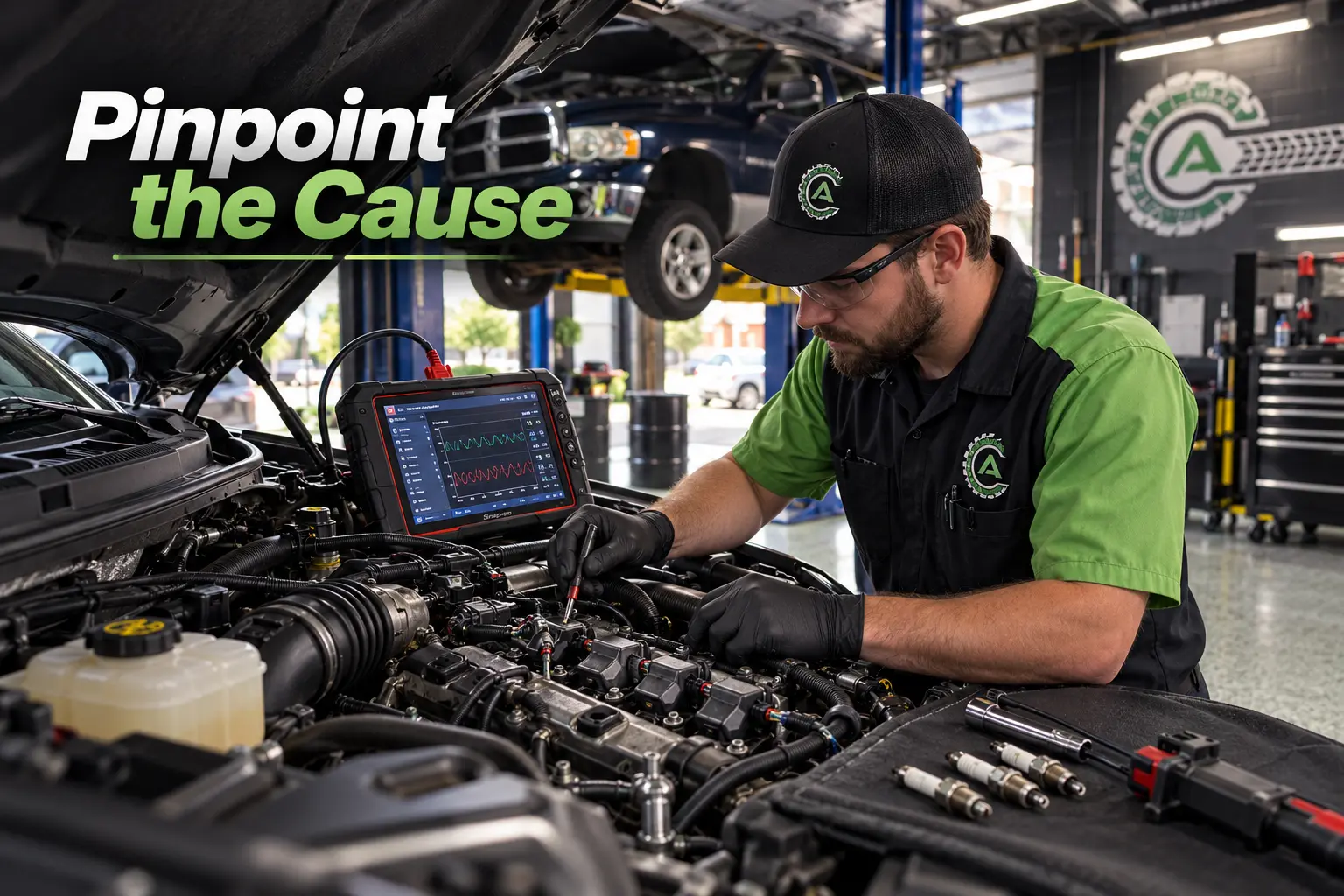
How Is an Engine Misfire Diagnosed?
Good diagnosis is a process of narrowing possibilities.
The exact sequence depends on the vehicle, symptoms and stored codes, but an engine misfire diagnosis may involve:
- Confirming the complaint and determining when the misfire occurs.
- Scanning for stored, pending and applicable diagnostic trouble codes.
- Reviewing freeze-frame information and live engine data.
- Inspecting spark plugs, ignition coils, wiring and connectors where appropriate.
- Checking fuel delivery and injector operation when the evidence points toward a fuel problem.
- Looking for intake or vacuum leaks that may create an incorrect air-fuel mixture.
- Testing compression or mechanical condition when ignition and fuel checks do not explain the problem.
- Verifying the repair and confirming that the misfire is no longer present.
This process matters because the same symptom can come from very different failures.
Accurate engine misfire repair York PA is not about automatically replacing the most common part. It is about proving what is wrong with that specific vehicle.
Will New Spark Plugs Fix an Engine Misfire?
They can if worn, fouled, damaged or incorrectly gapped spark plugs are the actual cause.
New spark plugs will not correct a failed fuel injector, vacuum leak, damaged ignition circuit, low compression, valve problem or timing fault.
If the spark plugs are due for maintenance, replacing them may still be appropriate. The important distinction is whether overdue maintenance is the cause of the current misfire or simply another issue that needs attention.
When Does a Misfire Need More Extensive Engine Repair?
Some misfires are resolved with ignition or fuel-system repairs. Others point to a deeper mechanical condition.
More extensive engine misfire repair York PA may be needed when testing identifies low compression, valve-train problems, engine timing concerns, internal wear or another mechanical fault.
When diagnosis shows that the problem goes beyond plugs, coils, injectors or other routine components, Accelerate Automotive’s engine and transmission repair service provides a direct path to the appropriate mechanical repair.
A misfire code alone does not mean the engine needs major work. Mechanical repair should be based on test results, not simply the code number or the severity of the vibration.
What Should York Drivers Do When a Car Starts Misfiring?
If your vehicle begins shaking, hesitating or running rough around York or West York, pay attention to when the problem happens.
Is the check engine light steady or flashing?
Does the misfire occur only at idle, during acceleration, after a cold start or all the time?
Has fuel economy changed?
Did the problem begin suddenly or develop gradually?
Those details can help during diagnosis.
Do not continue driving for days simply to see whether a serious misfire clears itself. If the warning light is flashing or the vehicle is struggling to maintain power, limit driving and have the problem evaluated promptly.